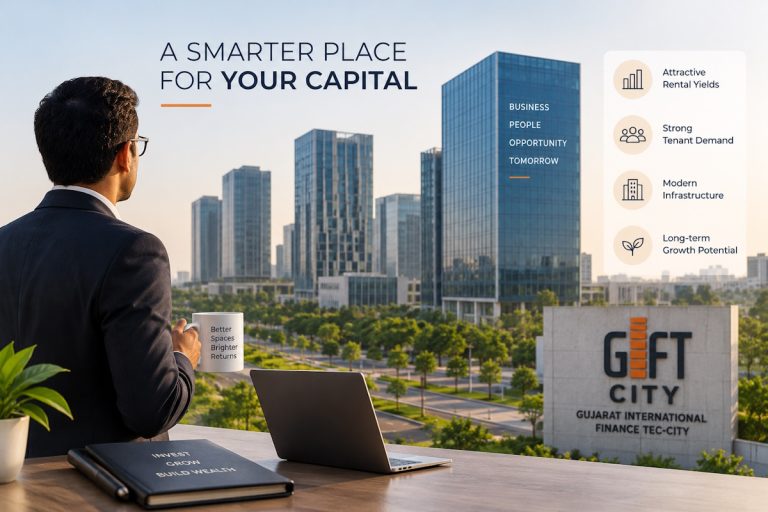

Multinational corporations are constantly searching for structural efficiencies that can optimize operational costs without compromising on talent, security, or technology. India has long been the global hub for Global Capability Centers, commonly referred to as GCCs, but a major policy shift is currently reshaping where these hubs are established. The introduction of the new GCC framework in Gujarat International Finance Tec-City, widely known as GIFT City, has altered the financial and operational calculations for multinational firms. By establishing a presence here, international companies are finding ways to streamline compliance while capturing massive bottom-line savings.
For institutional real estate investors, portfolio managers, and family offices, this regulatory shift represents a generational commercial real estate opportunity. The surging demand for Grade-A commercial office space gift city is no longer driven merely by speculative growth but by concrete, policy-driven cost savings that directly benefit multinational tenants. This comprehensive guide breaks down the financial dynamics of the new GCC policy, analyzes why these regulations save companies millions, and explains how savvy investors can position themselves to capture the resulting yield.
The GCC Revolution and GIFT City’s Strategic Ascent
The rise of GCCs in India has evolved from simple back-office operations into sophisticated centers of excellence that manage global engineering, finance, cybersecurity, and artificial intelligence. Historically, these centers were set up in mature technology hubs like Bengaluru, Pune, or Hyderabad. However, high congestion, rising commercial rents, and complex domestic tax structures have led executive decision-makers to seek out more competitive, specialized zones.
Defining the Modern Global Capability Center (GCC) in India
Today, a GCC is a strategic extension of a global enterprise. It acts as an internal engine driving product innovation, digital transformation, and high-value financial operations. Under the updated regulatory environment, setting up these high-performance centers in a Special Economic Zone or International Financial Services Centre environment allows companies to mitigate operational friction. If you want to analyze this shift from a macroeconomic standpoint, our commercial real estate trends report highlights how corporate occupiers are transitioning away from traditional metropolitan business districts in favor of planned financial free zones.
Why GIFT City IFSC is the Ultimate Regulatory Sanctuary
GIFT City operates as a functional offshore financial center within India, governed by a unified regulator, the International Financial Services Centres Authority. This regulatory single-window system simplifies setup procedures, eliminates multi-departmental red tape, and permits foreign entities to operate under liberalized foreign exchange rules. The alignment of global regulatory standards with Indian operational efficiencies makes it an incredibly attractive destination for financial institutions, technology giants, and multinational conglomerates looking to optimize their corporate footprints.
Financial Architecture: How the New GCC Policy Saves Millions
The core appeal of the new GCC framework lies in its direct, quantifiable impact on a corporate balance sheet. By transitioning operations to a specialized tax-free or low-tax jurisdiction, multinational firms can achieve immediate savings across capital expenditure, ongoing operational costs, and administrative compliance.
Tax Neutrality and Exemption Frameworks
The financial benefits begin with direct tax incentives. Businesses operating within the IFSC can avail themselves of a 100% corporate tax holiday for any consecutive ten years out of a fifteen-year block. Furthermore, the Minimum Alternate Tax, which typically impacts corporate profits in India, is reduced from 15% to 9% for companies operating within the IFSC, and is entirely waived for companies opting for the new tax regime. To fully understand these implications, you can read our specialized analysis of IFSC tax advantages to see how corporate structures can maximize these savings.
Operational Cost Arbitrage: CapEx vs. OpEx Breakdown
Setting up a global capability center in major Western cities or even primary Indian metros carries significant overheads. GIFT City offers Grade-A office spaces with competitive rental tariffs, combined with lower utility expenses and lower cost of living for employees. This operational cost arbitrage translates into savings of up to 20% to 30% on overall operating expenditures. Additionally, the exemption from Goods and Services Tax on input services, domestic procurement of goods, and capital assets ensures that the initial setup cost is substantially lower than in non-IFSC zones.
Currency Flexibility and De-risked Capital Repatriation
Another significant structural advantage is the ability to operate in freely convertible foreign currencies. Unlike standard domestic Indian operations, GCCs in the IFSC can execute contracts, pay international vendors, and hold balances in foreign currencies like USD or EUR. This eliminates foreign currency conversion costs and protects global enterprises from exchange rate volatility, making the repatriation of profits simple, compliant, and cost-effective. Navigating these compliance pathways is easier when you access our targeted GIFT City GCC policy brief.
Evaluating Commercial Office Space GIFT City: Key Selection Metrics
For real estate investors and corporate tenants alike, selecting the right physical asset within GIFT City requires looking past basic aesthetic features. The focus must be on regulatory compliance, zone-specific zoning, structural efficiency, and long-term utility.
SEZ vs. Non-SEZ Demarcation: Deciding Your Zone
GIFT City is divided into two distinct zones: the SEZ/IFSC zone and the domestic tariff area, or DTA. Multinational corporations aiming to leverage the GCC policy must locate their offices within the SEZ/IFSC zone to claim tax holidays and currency conversion benefits. Investors purchasing premium office assets must be incredibly precise about which side of the boundary they are buying on, as the tenant pool, rental yield profile, and capital growth drivers differ significantly between the SEZ and DTA zones.
Infrastructure Specifications for High-Performance GCCs
A modern GCC does not just need open desk space; it requires robust digital infrastructure. Global firms expect uninterrupted fiber-optic connectivity, Tier-IV data center availability, redundant district cooling systems, and dual-grid power backup systems. When evaluating a commercial property, investors should verify if the building meets international green building certification standards, such as LEED or IGBC, as global occupiers increasingly mandate sustainable working environments to comply with corporate ESG goals.
Technical Due Diligence and Vendor Quality
Before committing capital, institutional buyers must perform technical due diligence on the developers active in GIFT City. Choosing projects developed by tier-one builders with a proven track record of constructing institutional-grade commercial spaces reduces execution risk, ensures superior facility management, and protects the resale value of the property. Poorly designed floor plates or insufficient parking ratios can significantly impair the long-term leaseability of the office space.
Mitigating Risk and Maximizing Yield: The Investor’s Perspective
Investing in commercial real estate is fundamentally an exercise in risk mitigation and cash flow optimization. The influx of GCCs provides a highly predictable, creditworthy tenant profile that is unique to this economic zone.
Capital Appreciation Projections for Commercial Space
As more global enterprises recognize the scale of cost savings offered by the new policies, the demand for physical space is projected to outpace supply over the medium term. This structural imbalance makes commercial office space gift city an excellent vehicle for capital appreciation. Unlike mature markets where capital growth has plateaued, GIFT City is in its high-growth expansion phase, making early-to-mid-stage investments highly lucrative for long-term real estate portfolios.
Tenant Profiles and Rental Yield Sustainability
Traditional commercial offices in domestic markets often suffer from high tenant churn and vacancy risk. GCCs, on the other hand, commit to long-term leases, typically ranging from five to nine years, due to the substantial capital spent on customized fit-outs and local talent recruitment. These long lease tenures, combined with annual rent escalation clauses, translate into highly stable, predictable rental yield expectations that outperform standard commercial real estate benchmarks in other tier-one cities.
Understanding Exit Liquidity and Institutional Interest
A common concern for commercial real estate buyers is exit liquidity. Due to the high-quality tenant profiles and sovereign-backed infrastructure of GIFT City, institutional investors like real estate investment trusts, or REITs, and sovereign wealth funds are actively looking to acquire pre-leased commercial assets. This strong institutional interest provides individual investors and family offices with clear, highly liquid exit routes when they decide to realize their capital gains.
Aligning Your Investment Strategy with GIFT City Regulatory Cycles
Success in this specific micro-market relies on a deep understanding of local regulatory updates and policy implementations. Working with a dedicated advisory firm can help investors navigate these changes seamlessly.
The Importance of a Specialized Real Estate Partner
Navigating the nuances of SEZ laws, IFSC rules, and developer obligations requires local expertise. Gift City Realty serves as a strategic advisor, helping institutional buyers, NRIs, and corporate heads identify compliant, high-performing commercial assets. By leveraging deep local networks and market data, we assist clients in avoiding common pitfalls, such as buying properties with title issues or selecting layouts that do not meet the strict technical standards of global corporations. To begin planning your entry into this market, you can read our GIFT City investment guide to understand the step-by-step acquisition process.
Future-Proofing Your Commercial Real Estate Portfolio
The shift toward offshoring strategic business functions is not a temporary trend; it is a permanent restructuring of global corporate workflows. By acquiring commercial assets configured specifically for GCC tenants, real estate investors are positioning themselves ahead of a massive wave of global demand. Ensuring that your investments are aligned with the evolving regulatory frameworks in Gujarat, India, guarantees that your portfolio remains resilient, cash-flow positive, and highly valuable for decades to come.
Making Your Next Move in the GIFT City Commercial Market
The new GCC policy in GIFT City represents more than a collection of tax breaks; it is a fundamental shift in how multinational corporations manage global operations and real estate overheads. By offering a platform that combines tax neutrality, operational ease, and state-of-the-art infrastructure, GIFT City is poised to attract a massive volume of global capital and top-tier corporate tenants.
For investors, the opportunity is clear. Capitalizing on the growing demand for Grade-A commercial office space gift city allows you to lock in strong yield profiles and capture substantial capital gains as this world-class financial center continues to mature. Whether you are an institutional buyer looking for pre-leased office blocks or a multinational corporate real estate director planning your next strategic setup, acting decisively during this high-growth window is key to securing premium placement.
Frequently Asked Questions
1. How exactly does the new GCC policy save multinational corporations money in GIFT City?
The policy saves companies millions by offering a 100% corporate tax holiday for ten consecutive years, lowering the Minimum Alternate Tax, eliminating Goods and Services Tax on capital assets and input services, and allowing transactions to be executed in stable foreign currencies to remove foreign exchange costs.
2. What is the difference between SEZ and DTA office spaces in GIFT City?
SEZ/IFSC office spaces are classified as offshore zones, allowing tenants to access global tax exemptions, foreign currency operations, and unified financial regulations. DTA office spaces operate under domestic Indian laws and do not qualify for the offshore tax and regulatory benefits designed for GCCs.
3. What kind of rental yields can investors expect from commercial properties in GIFT City?
Due to the premium quality of tenants, such as multinational banks, technology hubs, and global capability centers, commercial real estate in GIFT City generally offers stable and attractive yields with multi-year lease commitments and built-in rent escalations, outperforming domestic market averages.
4. Can foreign companies and non-resident Indians buy commercial office spaces in GIFT City?
Yes, foreign companies, multinational entities, and NRIs can acquire and lease commercial real estate within GIFT City. The regulatory framework is specifically designed to facilitate foreign capital inflow and simplify property ownership processes through a streamlined, investor-friendly single-window system.